The Pheasant Hunter's Ammo Guide


- Key Takeaways
- Introduction
- Start With Shot Size, Not Gauge
- Pheasant Shot Size by Season and Range
- Converting Lead Shot Sizes to Bismuth and Steel
- Gauge: 12, 20 & Everything Below
- Choke: Matching Constriction to Shot and Season
- Where Nontoxic Pheasant Loads Are Required
- Pattern Your Gun Before the Opener
- Frequently Asked Questions
Key Takeaways
- Shot size is the first decision. Gauge and choke adjustments come afterward because pellet performance determines whether the load can reliably reach a pheasant's vitals.
- Lead #5 and #6 remain the traditional pheasant sizes. Steel and bismuth loads require either larger pellets, denser materials, or both to match comparable downrange performance.
- A 20 gauge kills pheasants cleanly inside 40 yards when paired with an appropriate payload and choke. The limitation is range and pattern density, not effectiveness.
- Improved cylinder and modified chokes cover most pheasant-hunting situations. Tighten constriction as birds become increasingly wary later in the season.
- Nontoxic ammunition is required on a growing number of public hunting areas. Regulations often determine ammunition choice before personal preference does.
- Build your load around bird behavior, cover, and shooting distance. The most effective pheasant shotgun shells are the ones that consistently produce clean recoveries.
Introduction
If you're standing at the ammunition counter before a pheasant hunt and find yourself overwhelmed by the choices, pump the brakes and take a breath. For most pheasant hunting, a 12 or 20 gauge loaded with #5 or #6 lead, or a #3 or #5 bismuth or bismuth-steel load, paired with an improved cylinder or modified choke will pull just about any rooster out of the sky.
The challenge is not finding a chart that explains how to choose lead shot sizes. Every upland hunter has seen those. The harder question is figuring out what replaces those familiar lead loads when regulations or preferences demand nontoxic ammunition. And that's where most buying decisions get complicated.
So, we’re going to resolve the three variables that matter most, in order: shot size, gauge and choke. Get those decisions right, and choosing pheasant shotgun shells becomes much simpler. Get them wrong, and even a quality gun and a well-trained dog can spend the day chasing runners.
Start With Shot Size, Not Gauge
What Size Shot for Pheasant?
The first decision is always shot size. Many hunters begin with gauge because that's the shotgun they own. In reality, pellet size determines whether individual pellets retain enough energy to penetrate feathers, muscle, and vital organs. Everything else works around that decision.
Shot numbering is simple. Higher numbers indicate smaller pellets. Smaller pellets increase pellet count and pattern density, while larger pellets carry more individual energy downrange.
That creates the fundamental tradeoff in pheasant hunting:
- Smaller shot creates denser patterns.
- Larger shot delivers greater penetration and energy.
Most hunters don't move to larger shot because they're missing birds. They move to larger shot after losing birds they've hit. A crippled rooster that sails into cattails or runs through CRP is often a shot-size problem.
For practical purposes, every recommendation in this article assumes a pheasant-hunting window of roughly 25 to 40 yards. That's where most wild-bird opportunities occur and where shot size becomes especially important.
When hunters ask what size shot for pheasant, they're really asking how to balance pattern density against terminal performance. The answer changes with season, cover, pressure and ammunition type, but shot size remains the foundation of the entire setup.
Pheasant Shot Size by Season and Range
Best Shot Size for Pheasant
The best shot size for pheasant depends on how birds are behaving. Early season roosters often hold tighter in lighter cover. Birds flush close, shot distances are shorter, and pattern density becomes more important than maximum pellet energy.
Late-season birds are different. They've been pressured for months, flush farther out, and frequently need more retained pellet energy at distance to hit the dirt.
The general rule is straightforward:
- Early season, 25 to 35 yards: favor smaller shot and higher pellet counts.
- Late season, 35 to 45 yards: favor larger shot or denser materials.
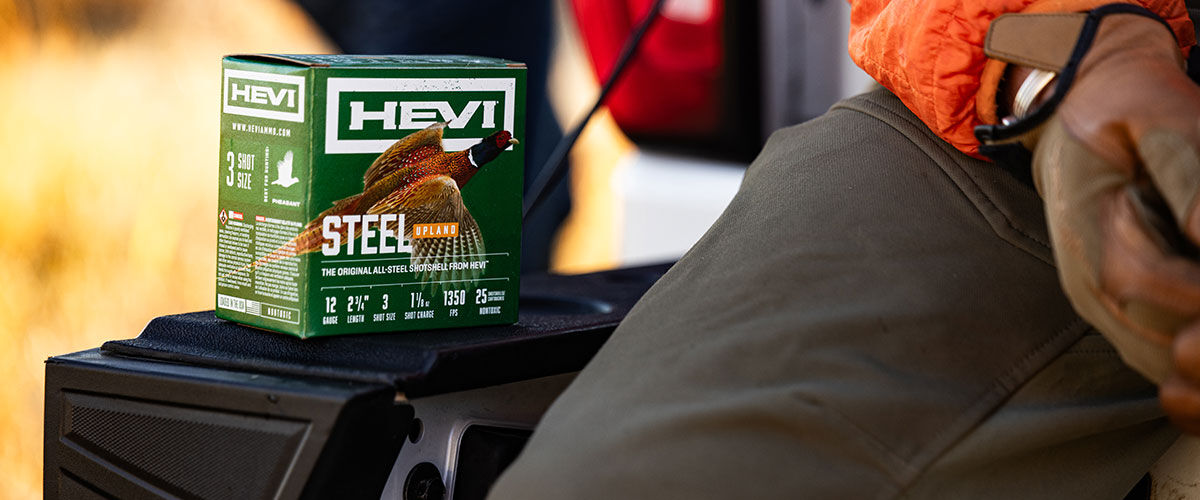
For hunters using HEVI upland ammunition, available upland shot sizes include #7, #6, #5, and #3 depending on product line and gauge. HEVI upland offerings include steel loads, HEVI-Bismuth Upland loads, and HEVI-Hammer Upland layered bismuth-steel loads.
Shot Size Recommendations
| Shot Size | Material | Working Range | Best For | HEVI Load |
|---|---|---|---|---|
| #7 | Steel | 25-30 yards | Early-season birds, mixed-bag hunts, close-flushing upland birds | HEVI-Steel Upland |
| #6 | Steel | 25-35 yards | Early- to mid-season pheasants | HEVI-Steel Upland |
| #5 | Bismuth | 30-40 yards | All-around pheasant hunting | HEVI-Bismuth Upland |
| #5 | Bismuth-Steel | 30-40 yards | General-purpose nontoxic pheasant hunting | HEVI-Hammer Upland |
| #3 | Bismuth or Bismuth-Steel | 35-45+ yards | Late-season roosters and wild flushes | HEVI-Bismuth Upland or HEVI-Hammer Upland |
One often-overlooked scenario is the mixed-bag walk where pheasants and quail share the same property.
In that case, choose the smaller of the two shot sizes and pair it with a more open choke. The goal is preserving pattern density for smaller birds while still carrying enough energy for pheasants encountered at reasonable distances. A load built exclusively for late-season roosters can be unnecessarily destructive on quail and make close opportunities harder.
Converting Lead Shot Sizes to Bismuth and Steel
What Size Steel Shot for Pheasant?
As nontoxic requirements expand, the most common question is no longer what size lead shot to use. It's how to replace it. The answer is simple:
Nontoxic pellets are generally less dense than lead, so matching lead performance requires moving up in pellet size, moving up in density, or both.
Practical Conversion Guide
| Lead Size | Steel Equivalent | Bismuth Equivalent |
|---|---|---|
| #6 Lead | #4 Steel | #6 or #5 Bismuth |
| #5 Lead | #3 Steel | #5 Bismuth |
| #5 or #6 Lead | N/A | Same size or one size larger |
The reason comes down to density. A denser pellet carries more energy at longer distances. When density drops, pellet size must typically increase to maintain similar terminal performance.
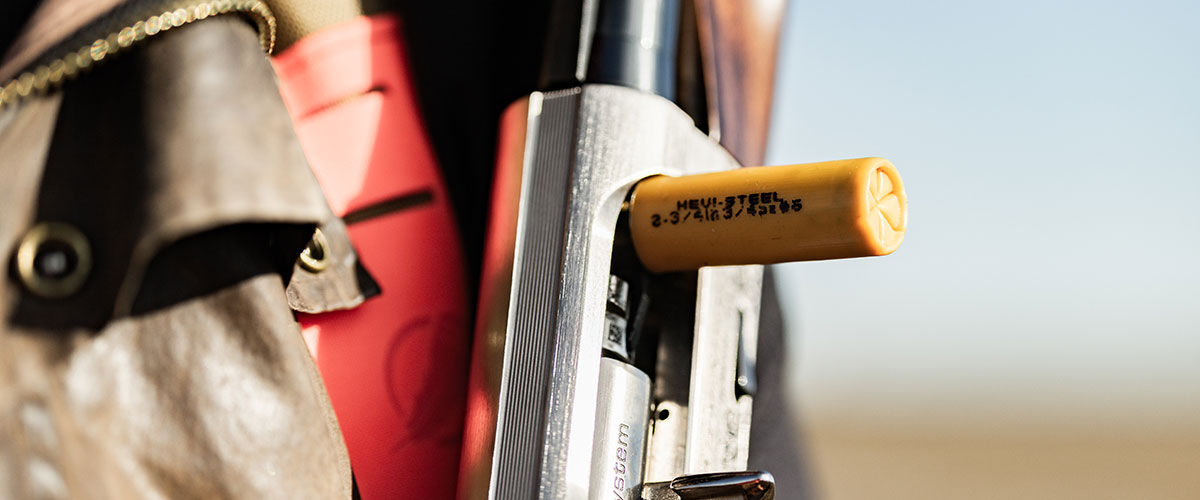
HEVI's upland product lineup addresses this in different ways. HEVI-Steel Upland uses precision steel pellets, while HEVI-Bismuth Upland and HEVI-Hammer Upland leverage denser bismuth shot to improve downrange effectiveness.
For many pheasant hunters, the best nontoxic shot for pheasant is bismuth because it allows them to stay closer to familiar lead-shot sizing while retaining strong downrange performance.
Gauge: 12, 20 & Everything Below
Best Gauge for Pheasant Hunting
Gauge determines how much shot you can launch with a single shell. It does not determine whether a pheasant can be killed cleanly. The difference is payload capacity and pattern density.
12 Gauge
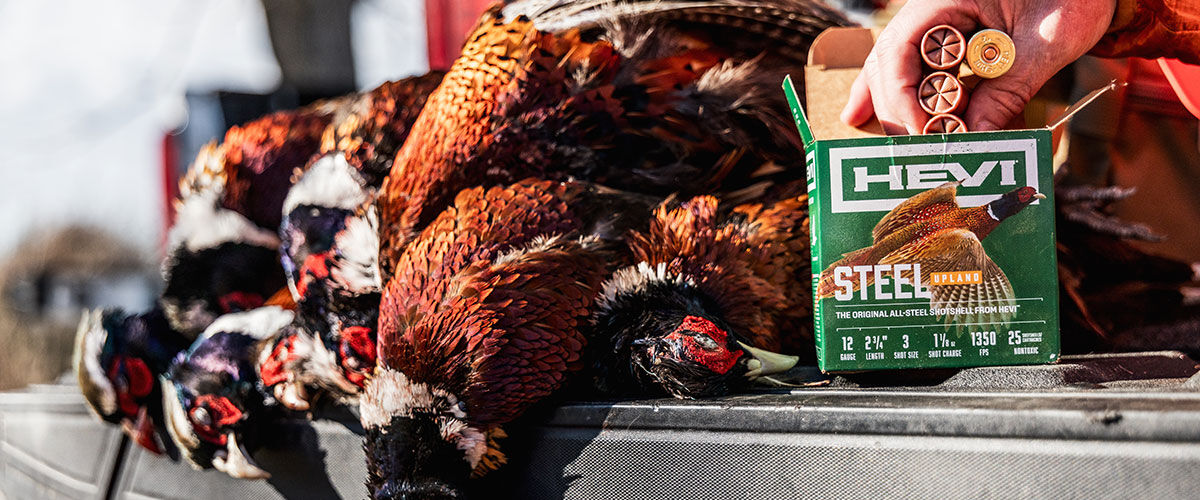
The 12 gauge remains the default pheasant gun because it carries larger payloads and provides the most flexibility across changing conditions. From close-opening-day birds to wild late-season roosters, the 12 gauge offers the widest margin for error.
20 Gauge
The popularity of 20 gauge pheasant loads has exploded among hunters who cover serious miles behind bird dogs. A modern 20 gauge loaded correctly is fully capable inside 40 yards.
When hunters ask what size shot for pheasant 20 gauge, the answer is typically #5 bismuth or #3 bismuth-steel. One excellent example is HEVI-Hammer Upland 20 gauge 3-inch #3, carrying a 1-ounce payload at 1325 fps, or HEVI-Bismuth Upland 20 gauge #5 with a 1-ounce payload. These loads provide enough pellet energy for roosters while keeping gun weight manageable.
The biggest limitation isn't energy. It's pellet count. As gauges get smaller, nontoxic loads can run out of pattern density before they run out of killing power.
16 Gauge
The 16 gauge remains a favorite among traditional upland hunters and performs exceptionally well to about 40 yards when paired with appropriate shot sizes.
28 Gauge
The 28 gauge can be extremely effective over pointing dogs and close-working birds. Think of it as a 30-yard-to-35-yard pheasant tool rather than a late-season long-range solution.
.410 Bore
Modern ammunition has improved .410 performance considerably, but it remains a specialized choice. Inside close ranges with disciplined shot selection it can work, but it offers the least margin for error.
Choke: Matching Constriction to Shot and Season
Best Choke for Pheasant
The best choke for pheasant hunting depends on how far birds are flushing. For most hunters:
- Improved Cylinder: Early season
- Modified: Season-long default
- Improved Modified: Late season
- Full: Specialized long-range situations
Early-season birds often flush close. Improved cylinder gives enough pattern width to capitalize on fast opportunities without creating excessive holes in the pattern. As birds become educated and begin flushing farther away, modified becomes the sweet spot. Late-season hunters facing pressured roosters at longer ranges often move to improved modified or full.
A critical consideration with nontoxic ammunition is compatibility. Bismuth loads are widely used in older guns and fixed-choke barrels because the pellets are softer than steel. Steel loads require greater attention to choke restrictions and manufacturer recommendations.
Equally important: do not change shot size and choke simultaneously during testing. Change one variable. Pattern it. Record results. If you alter both at once, you'll never know which change improved or degraded performance.
Choke Selection Table
| Choke | Constriction | When to Use | Shot Material Notes |
|---|---|---|---|
| Improved Cylinder | Light | Early season, close flushes | Excellent with lead, steel, and bismuth |
| Modified | Medium | Best all-around pheasant choke | Strong choice for most hunters |
| Improved Modified | Medium-Tight | Late season, longer shots | Pattern before hunting |
| Full | Tight | Long-range specialists | Confirm compatibility with ammunition manufacturer |
Where Nontoxic Pheasant Loads Are Required
Do You Need Nontoxic Shot for Pheasant?
Often, yes. A growing number of federal and state-managed properties as well as many private game preserves require nontoxic ammunition for upland hunting. Regulations vary by location and can change from year to year, making it essential to verify requirements before traveling.
Examples include wildlife areas and specific public lands with expanded nontoxic shot requirements administered by agencies such as the Minnesota Department of Natural Resources, California Department of Fish and Wildlife, and Illinois Department of Natural Resources. Hunters should always review current agency regulations before a hunt.
The practical solution is selecting one nontoxic load you trust and using it everywhere.
That eliminates the need to carry separate lead and nontoxic boxes, avoids confusion at property boundaries, and ensures your gun is patterned with the ammunition you'll actually hunt with.
HEVI's upland lineup was developed specifically around that need, offering steel, bismuth, and layered bismuth-steel options for hunters operating under nontoxic regulations.

Pattern Your Gun Before the Opener
How to Pattern a Shotgun for Pheasant
The only way to know what a load-and-choke combination actually does is to shoot it at paper. Ignore marketing claims, internet opinions, and theoretical calculations.
Pattern testing is simple:
- Place a 30-inch circle target at 40 yards.
- Fire your chosen load and choke combination.
- Count pellet strikes inside the circle and repeat with alternative combinations.
The resulting pattern tells you more than any ammunition box ever will. Patterning resolves the central question every hunter faces: does this setup maintain sufficient pellet density across the 25-to-40-yard window where most pheasant opportunities occur?
Spend an hour on the range before the opener, and you'll enter the season with confidence rather than hope.
Frequently Asked Questions
What size shot is best for pheasant hunting?
For most pheasant hunting, #5 and #6 lead remain the traditional choices. In nontoxic ammunition, #5 bismuth and #3 bismuth-steel loads are among the most versatile options. Early-season birds typically favor smaller shot with higher pellet counts, while late-season roosters often justify larger shot or denser materials that maintain energy farther downrange. The best shot size for pheasant depends on expected range, bird pressure, and whether regulations require nontoxic ammunition.
Is a 20 gauge enough for pheasant?
Yes. A 20 gauge is more than enough for pheasants inside 40 yards when loaded appropriately. Modern 20-gauge pheasant loads using bismuth or layered bismuth-steel payloads provide excellent terminal performance. The primary limitation is pattern density at extended ranges, not killing power. Hunters who walk long distances behind pointing dogs often prefer the reduced weight and recoil of a 20 gauge.
What choke should I use for pheasant hunting?
An improved cylinder choke is ideal for close-flushing early-season birds. Modified is the best all-around choice and covers the majority of pheasant situations. Improved modified works well for longer late-season shots, while full chokes are generally reserved for specialized long-range hunting. Most hunters can successfully hunt an entire season with a modified choke.
Do I need nontoxic shot for pheasant hunting?
Many public hunting areas now require nontoxic ammunition. Requirements vary by state, agency, and specific property. Always verify regulations before hunting. If you frequently hunt public ground, using one effective nontoxic pheasant load everywhere can simplify gear choices and eliminate compliance concerns.
Can I shoot bismuth through a fixed full choke?
Generally, bismuth is considered suitable for many older shotguns and fixed-choke barrels because it is softer than steel. However, hunters should always follow the ammunition manufacturer's recommendations and confirm compatibility with their specific firearm. When hunting with vintage shotguns, bismuth is often the preferred nontoxic alternative because it more closely mimics traditional lead performance while remaining nontoxic.